
Women's Alpaca Sweater: Wool, Blends, Care | MONA WIE
There is a wool that does what no other wool does. It comes from an animal that lives at 4,500 metres in the Andes, where temperatures shift from -25°C to 30°C in a single day. To survive, the animal grew a fibre with a hollow core — air trapped inside the thread itself — which insulates more efficiently than any solid-fibre wool we know.
That fibre is alpaca. It is the foundation of the warmest, lightest, and longest-wearing knitwear at MONA WIE.
WHAT IS ALPACA WOOL?
Alpaca wool is the fleece of the Andean alpaca — a smaller, lighter cousin of the llama. The animals are raised in small family farms in Peru and Bolivia, often above 4,500 metres. They graze freely on local grasses and grow a coat designed to insulate against extreme temperature swings.
Once a year they are sheared by hand. The fleece is cleaned, sorted by fineness, and spun into yarn. No chemical treatment is required.
The result is one of the most distinctive natural fibres in the world — and one of the six we work with at MONA WIE. (You can read more about the others in Why we work only with natural fabrics.)
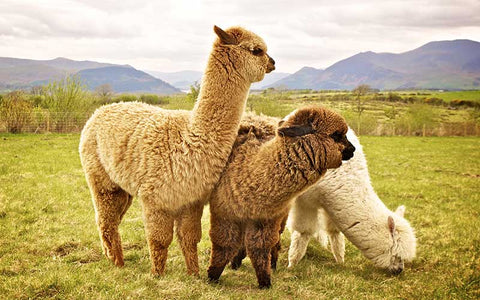
WHAT MAKES ALPACA DIFFERENT
Four things, in order of importance.
It regulates temperature
Each alpaca fibre has a hollow core. Air is trapped inside the thread itself, which insulates more efficiently than any solid-fibre wool — including merino and cashmere, where insulation depends on air between fibres rather than inside them. The fibre traps warmth in cold weather and releases moisture in heat. The practical result: an alpaca sweater is wearable across more temperatures than its description suggests. Comfortable in winter under a coat. Wearable in spring without one. A garment for three seasons, not one.
It doesn't pill
The fibre length of alpaca is unusually long — significantly longer than cashmere or merino. Pilling occurs when short fibres work their way to the surface and tangle. With alpaca, that mechanic is largely absent. A well-cared-for alpaca jumper keeps its appearance for years rather than seasons. Told another way: lower cost per wear.
It is hypoallergenic
Alpaca contains no lanolin — the natural wax in sheep's wool that causes itchiness and triggers reactions in wool-sensitive skin. For anyone who has tried to wear traditional wool and given up, alpaca is a different experience entirely. Soft against the neck. No prickle.
It improves with wear
Like cashmere, alpaca becomes softer with each wearing — provided the yarn is spun by a mill that knows what it is doing. The fibre holds its structure for years while losing its initial stiffness.
ALPACA VS CASHMERE
The two fibres are often compared. Here is what is true.
Weight for weight, alpaca is warmer — the hollow-fibre structure traps more air. It is more durable — longer fibres mean less pilling. It is hypoallergenic — cashmere is too, but alpaca more reliably so. And it is more sustainable: one alpaca produces roughly three times the usable fibre per year that a cashmere goat does (2–3 kg vs. less than 1 kg), and alpacas graze without damaging the land, leaving the roots of grasses intact.
Cashmere has its own qualities — a particular softness on the skin, a luxurious historical association. The choice is not really alpaca or cashmere. The most interesting pieces are often both.


WHEN ALPACA MEETS OTHER FIBRES — THE MONA WIE BLENDS
A pure 100% alpaca sweater is exceptional. But the pieces that get worn season after season are often blends. Each blend changes what the sweater does, and changes who it is for.
Alpaca + Cashmere + Silk — the Aurélie sweater
40% baby alpaca, 30% silk, 30% cashmere (the "Cashlux" blend). The silk gives the surface a faint lustre and improves drape. The cashmere adds an extra layer of softness against the skin. The alpaca holds the warmth and the structure. A crew-neck sweater that reads more like an evening piece than a winter one — refined enough to wear under tailoring, warm enough to wear alone. The same Aurélie silhouette is also produced in a second blend: 65% baby alpaca, 25% silk, 10% merino. Lighter, slightly more fluid.
Alpaca + Merino + Cotton — the Chris sweater
55% baby alpaca, 10% merino, 35% cotton (the "Eco Puno" blend). Cotton gives the piece weight and stability for an oversized cut. Merino adds resilience. The alpaca contributes softness and warmth without making the sweater heavy. Available in deep navy, lilac, and other seasonal colours.
Alpaca + Mohair + Merino — the Raphaël neckwarmer
40% alpaca, 20% mohair, 40% merino. Mohair brings a subtle halo of fibre to the surface, giving the piece a faint, almost crystalline texture. More couture object than winter accessory.
All MONA WIE alpaca pieces are spun by Filitaly-Lab — an Italian mill specialised in the highest grades of South American alpaca. The Aurélie, Chris, and Raphaël are available in any colour from the Filitaly colour cards. Contact us for yarn samples.
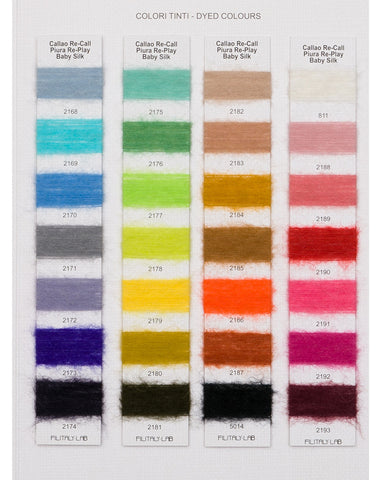
Baby Silk colour card
HOW TO WASH AND CARE FOR AN ALPACA SWEATER
Alpaca needs less washing than most other wools. The fibre is naturally smooth and resists odour absorption. Between wears, air your sweater on a hanger for a few minutes — but don't leave it hanging too long, or the weight can stretch the shoulders.
For small marks, blot gently with cold water.
For a full wash, hand-washing is preferable. Your MONA WIE alpaca sweaters can also be machine-washed on a wool or delicate cycle (maximum 30°C) inside a mesh laundry bag.
If hand-washing:
- Soak in cold water with a wool-safe detergent or mild shampoo.
- Press gently — never rub or twist. Friction breaks the fibres.
- Rinse several times in cold water until clean.
To dry:
- Lay flat on a towel and roll to absorb excess water.
- Dry flat, away from direct sunlight and heat.
- Never tumble dry. Heat and motion shrink and distort alpaca irreversibly.
FAQ
Why choose an alpaca sweater over cashmere?
Weight for weight, alpaca is warmer, more durable, and more sustainable than cashmere. It doesn't pill. It requires less washing. One alpaca produces roughly three times the usable fibre a cashmere goat does in a year — without degrading the land it grazes on.
How do you wash a 100% alpaca sweater?
By hand in cold water with a wool-safe detergent, or on a machine wool/delicate cycle (maximum 30°C) inside a mesh laundry bag. Lay flat to dry. Never use the tumble dryer.
Is an alpaca sweater warm in winter and cool in summer?
Yes. The hollow core of the alpaca fibre traps air inside the thread, which insulates against cold and releases moisture in heat. The result is a sweater that works across three seasons rather than one.
What are the MONA WIE alpaca blends?
The Aurélie sweater is baby alpaca with silk and cashmere, or baby alpaca with silk and merino. The Chris sweater is baby alpaca with merino and cotton. The Raphaël neckwarmer is alpaca with mohair and merino. Each blend produces a different texture and drape.
Where does MONA WIE's alpaca wool come from?
The fibre is grown in the Andes — primarily Peru and Bolivia, at over 4,500 metres altitude. It is spun in Italy by Filitaly-Lab. The finished sweaters and accessories are in Europe. From fibre to garment, a fully traceable European supply chain — no chemical treatments at any stage.
Cet article est aussi disponible en français.
Hinterlassen Sie einen Kommentar
Bitte beachten Sie, dass Kommentare vor der Veröffentlichung freigegeben werden müssen